Description
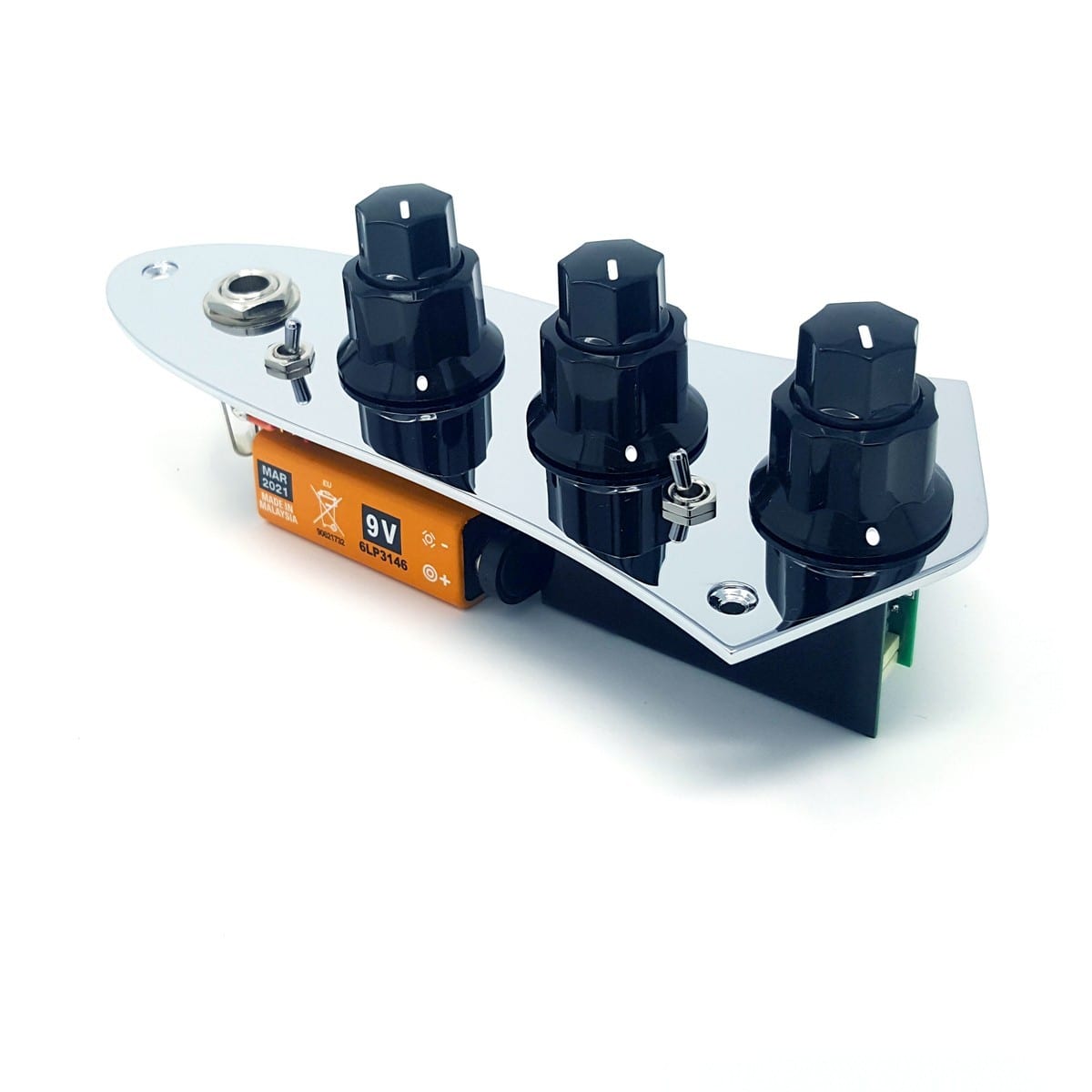
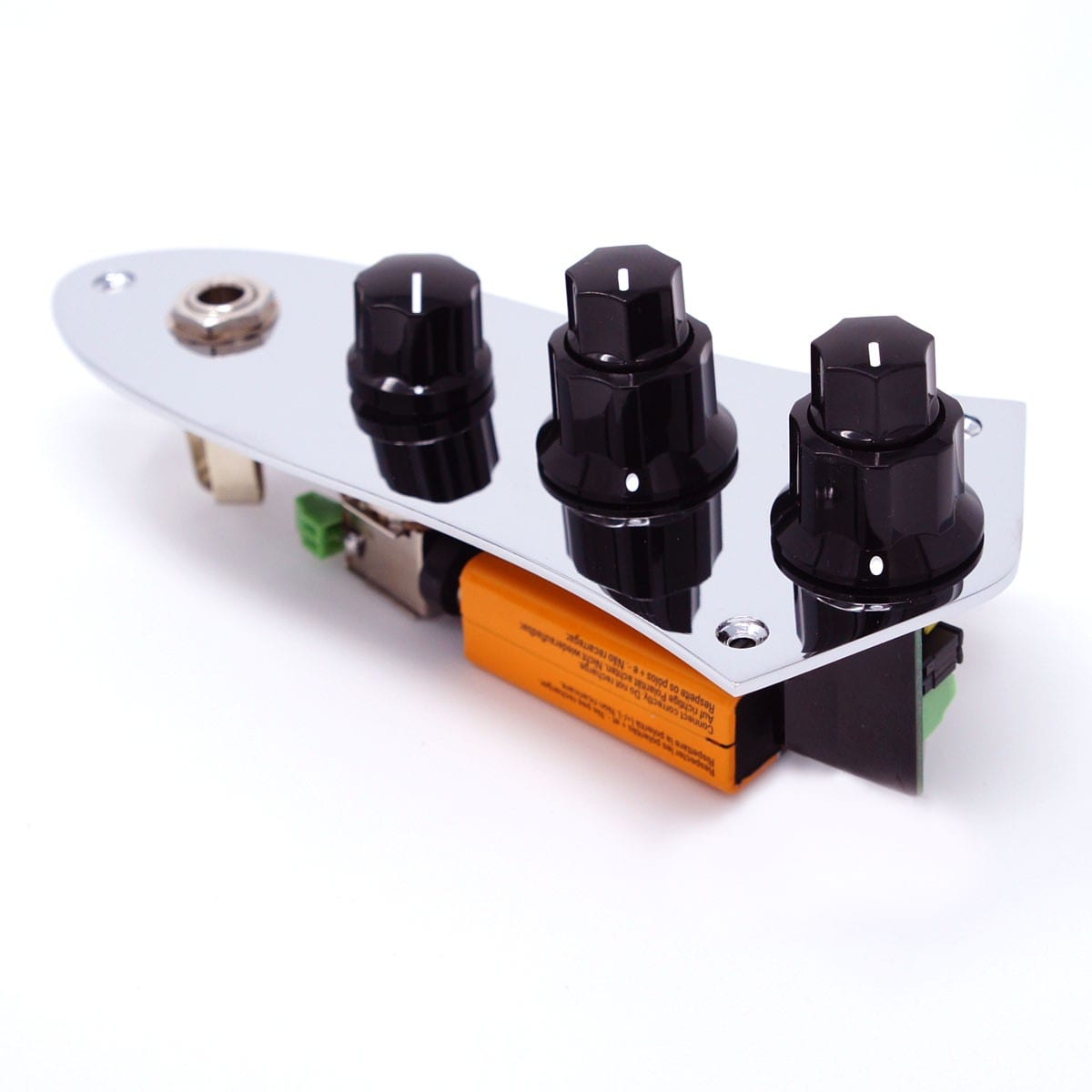
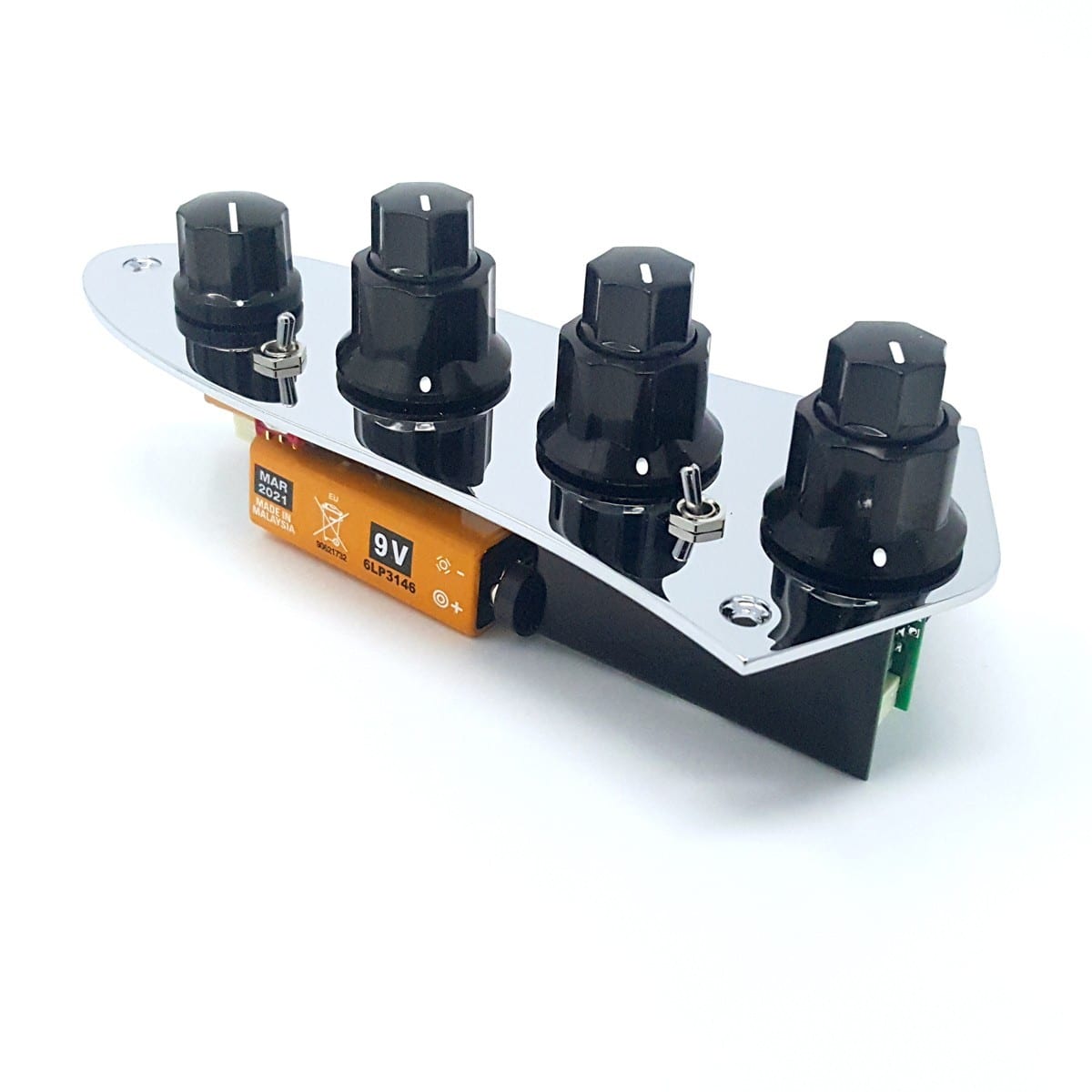
J-TONE: 2 Stacks, 1 Single
J-RETRO: 3 Stacks
DJ-RETRO: 3 Stacks
J-RETRO DELUXE: 3 Stacks, 1 Single
MARCUS RETRO: Stacks, 1 Single


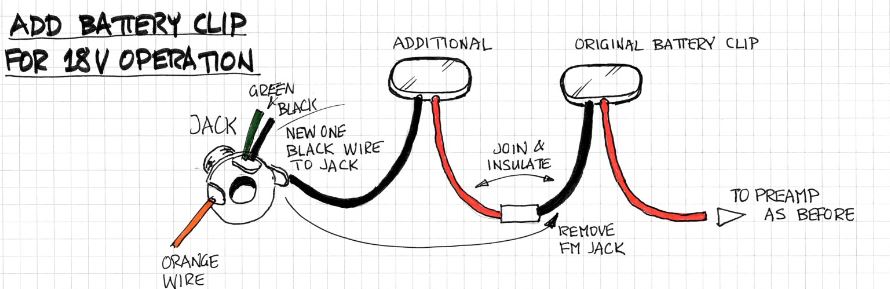
All our products, although supplied with a single 9V battery clip, are designed to work 9V or 18V out of the box. Just add the additional battery, or connect to an 18V battery box, no other changes are necessary.
Battery life depends on the battery type, quality, and spec. There’s not a one size fits all answer.
The J-Tone requires just over 2mA of current. So a battery with a capacity rating of 500mA should last ~250 hours.
If battery voltage is measured, that should always be done whilst under load, especially if a battery has had some use. Once battery voltage reads below 6V under load, it should be replaced.
The chips are spec’d to work down to 6V, but they will often work to a much lower voltage. See below about measuring the battery voltage.
DON’T DO THIS:
Don’t disconnect and take the battery out of an instrument to measure the battery. It will often be a false reading if the battery has been used to any extent.
IMPORTANT – Measuring The Battery with an East Preamp:
(The reason for having the battery connected, is that a weak battery can still show what appears to be a decent voltage without the preamp)
We have good number of preamps out there with EMG Actives, and they work well, with happy customers who say they are a good combination.
About Passive Tone Pots
Many of our units have Passive Tones. Our tone pots have the same capacitors as EMG but the tone variation will occur more towards the end of the rotation due to our pots. The maximum effect will be the same as the EMG tone pots. In other words, the passive tone won’t be as smooth as the EMG pots.
+ J-Retro is fine.
+ J-Deluxe will work fine except the our passive tone is 250K whereas the EMG is 25K.
* We use the same capacitors as EMG but since our pot is set for passive pickups, although it will still work, all the action will be towards the backed off setting, ie the darkest tone. It won’t be as smooth as the EMG pot, in terms of rotation versus effect.
+ UNI-PREs have a passive path that isn’t useful with EMG Actives, since the pickups aren’t just a ‘passive’ coil.
* passive is more is effectively EQ bypass.
If I connect the red wire (+) to the battery, can the uni-pre 5 handle the EMG impedance?
+ Connecting EMG Red Wires to the UNI-PRE + Red Wire is fine.
+ No issue the Pots in the UNI-PRE, each PU has an Input Buffer stage that feeds the Vol & Blend circuit.
+ The UNI-PRE Passive Tone is a higher value than the EMG, but it will still work.
* The Tone Mellow Factor will be the same, but the effect will be more towards to end of the Pot Rotation.
The MMSR, like the original Pre EB units, doesn’t have any amplification or gain when the knobs are set at their Mid Points to increase levels beyond the output of the pickup.
The MMSR preamp has the same input stage and treble control as the Pre EB to allow for the same interaction between the treble control settings and the pickup.
As for the Stingray sound, it’s not the preamp alone which makes it, it’s the complete combination of all that the instrument consists of.
Single-coil pickups are prone to buzz, especially when used with preamps that amplify the signal. Shielding the pickup cavities with copper foil and grounding it to the bridge ground wire can help mitigate this issue.
How to diagnose noise issues?
How to ensure proper grounding?
Where to find shielding guides?
My stacked knobs are rubbing against each other. What can I do?
This issue typically arises when the upper knob has been bumped, causing a slight bend in the middle shaft. You can try to carefully straighten the shaft yourself, but proceed with extreme caution as any sharp movement may break it.
To straighten the shaft:
The MMSR preamp’s compatibility with the 5-string Stingray is complicated by the 3-way pickup selector switch. Workarounds include rewiring the existing switch, installing a separate switch for the East UK preamp, or permanently wiring the pickup in a preferred configuration.
First, ensure you are using a fresh battery. A low battery can cause distortion, even if it shows sufficient voltage when not under load.
Next, check if the distortion occurs in passive mode. If so, the issue lies elsewhere in your setup.
If the distortion only happens in active mode, try lowering the volume knob on your bass. East UK preamps are powerful and can generate high output levels, especially with significant EQ boost. Lowering the volume creates more headroom and avoids clipping.
Yes, some looseness in the treble push/pull knob is normal, particularly compared to standard single-shaft knobs. This is due to the complex mechanism required for the dual concentric rotation and the up/down motion of the bright switch within a compact 9mm pot. Rest assured, ALPS pots are known for their durability and reliability, and the looseness does not affect their functionality.
The J-Retro focuses on active functionality. It features a smooth active blend, pickup gain trim for each pickup, a bright switch on the treble control, and a sweepable mid control. The passive signal path is minimal and lacks a passive tone control (except for the J-Retro Deluxe).
The J-Tone emphasizes replicating the original passive design while adding bass and treble active EQ. It offers Vol/Vol/Tone or Vol/Blend/Tone configurations for an authentic passive signal. The passive tone control functions in both active and passive modes. It also includes a plug-in tone cap for adjustable passive tone color and frequency wheels for customizing the bass and treble voicing.
East UK preamps use sealed pots, making it unlikely that dirt is the culprit. The crackling is usually caused by the inner and outer shafts of the stacked knobs momentarily losing contact during rotation. Cleaning the pots is not recommended as it can damage the sealing and potentially worsen the issue.
First, ensure that your pickup cavities are properly shielded. Use copper foil and connect the shields to the ground wire of your output jack. (see faq How to prevent buzzing… for more detailed info)
Next, check the height of your pickups. They should be adjusted close enough to the strings for a strong signal without causing interference.
If the noise persists, it could be inherent to single-coil pickups, which are known for their susceptibility to hum. Consider using hum-canceling pickups or explore further noise reduction techniques.
East UK preamps are known for their high-quality components, flexible EQ options, and focus on preserving the natural tone of the instrument. Unlike many other preamps, East UK designs feature a separate amplifier stage for each EQ band, resulting in greater precision and minimal interaction between controls. This allows for a more powerful and focused EQ that helps you dial in your desired sound with accuracy. The company prioritizes performance over cost-cutting measures, ensuring a low noise floor and a pristine signal path.
Crackling noises when turning knobs are typically not caused by dirty pots in East UK preamps, as the pots are sealed. The issue usually stems from the inner and outer shafts of the stacked knobs making and breaking contact as you rotate them. This is particularly noticeable with the treble knob due to the additional push-pull bright switch mechanism. While the pots are high quality and durable, this slight play in the shafts is a known characteristic.
To minimize the crackling, try grounding yourself to the plate, jack, or strings with one hand while rotating the upper knob with the other. If this reduces the noise, consider installing a spring between the upper and lower knobs to maintain ground contact.
If the issue persists or worsens, it could indicate a bent shaft, which might be carefully straightened. However, extreme caution is advised, as any sharp movement could break the shaft. For severe cases, returning the unit to East UK for pot replacement is recommended.
Distortion in active mode, especially at higher volumes, can occur due to the limited headroom provided by a 9V battery. The J-Retro, with its extensive EQ options, can generate high signal levels that exceed the battery’s capacity, leading to clipping.
To address this:
You can reach East UK via:
Sales: sales@east-uk.com
Tech Support: tech@east-uk.com
Info: info@east-uk.com
Our preamps were designed first and foremost to unlock and expand the great sounds within passive pickups. They work with active pickups too.
+ Is the EQ fully working, bass/treble & mid/sweep?
Some tests you can do to check if either of the modules appears to attenuate the signal level:
+ The Orange Wire (Oe for short), which feeds the jack, can be disconnected from the Mid Sweep module.
• Then you can use as a signal tracer when the bass is connected to a rig.
+ To check the raw PU signal:
• Connect Oe in parallel with the Red wire going into the Bass/Treble module.
• Is the raw PU signal at a reasonable level?
• So this is the reference signal and level the Bass, Mid, and Treble EQ has to work with.
• (Remove the Oe wire once the test is complete)
• Do you have the original PU?
• Some aftermarket PUs can have lower output than original MM PUs.
+ To check the Bass/Treble module assuming the raw PU signal is OK:
• Remove the Yellow Wire from the 3W Screw Terminal.
• Insert the Oe wire in its place and tighten. (Bypassing the Mid)
• With Bass & Treble in their centre clicks, is the level about the same as the raw PU?
• Do the Bass & Treble controls boost to good additional level when turned CW?
• There is a Red Jumper Link in the middle of the circuit board, swapping the setting (middle and pin by green pot) often improves aftermarket pickups.
• Findings from the tests above?
• Return the Yellow Wire to the middle aperture of the 3W Terminal Block.
+ Assuming the level and operation of the Bass/Treble is satisfactory, to check the Mid:
• Oe returned to the middle aperture of the Mid 3W Terminal Block.
• With upper Mid knob in its click, is the signal level the same as the Bass/Treble set in their clicks?
• Upper knob CW to max boost and sweep the lower knob to sweep through its frequency range.
+ Like the original Pre-EB MM EQs, the East MMSRs don’t add any gain when the EQ knobs are set to neutral.
Passive Mode means the system is entirely powered by the energy from the pickups alone, hence no positive gain adjustment. (So passive mode operates without a battery in place, like the old school passive basses)
The only way to balance active and passive is to make sure that the active gain trims are fully backed off.
Then, using the vol set at max for passive, in active, compensate for any increased levels dialled in using the EQ, by backing off the volume.
Yes, since many players find it a plus to have the passive roll-off in active mode as well as passive, the system was designed that way.
PASSIVE TONE WITH ACTIVE MODE
+ Players who work with lots of styles in the same gig such as functions and theatre productions, for example:
* Often set up a brighter sound with the active controls.
* Then for more mellow pieces, leave the active controls put, and just back off the tone.
* Fully up again for the brighter sound setting.
The thought was that it’s more of a bonus overall, and we’ve that many pro players breathe a sigh of relief when they find the passive tone works in active and passive. And comments like – “why doesn’t everyone do it that way?”
NOISE CANCELLING HUMBUCKERS
============================
+ Total noise cancellation is virtually impossible.
* For it to be perfect, the coils would need to be in exactly the same position, physically exactly the same size and construction, with mirror image coils.
* To call a pickup noiseless is rarely a truth, buyers are misled.
SINGLE COILS
============
+ Often based on original vintage designs, they are the easiest to make/replicate and often sound really pleasing.
* This type is the most prone to interference but grounded copper foil screening in the pickup cavities can help massively, even just the on ‘floor’ of the cavity can make an enormous difference.
SCREENED HUMBUCKERS
=====================
+ A combination of hum-cancelling coils and screening can help to create a virtually silent pickup.
* It is important that the pole pieces and/or magnets are grounded.
GROUNDED POLE PIECES
=====================
+ Vintage pickups rarely had their magnets or magnetic pole pieces grounded.
+ Many modern pickups do have grounded pole pieces and magnets, but making an electrical connection with magnets can be an issue.
+ Where adhesive-backed copper foil is taped across the underside of magnets, it can work for a while but may eventually lose contact. The adhesive needs to be conductive but the conductivity is poor with many lower cost types of foil tape, that state conductive adhesive.
The UK left the EU group of countries, at the end of 2020. Since then, the way sales taxes are paid has changed.
Your sales taxes are now paid in locally instead of the UK.
Pre Brexit the taxes would be charged by the UK – 20% VAT, so our units were 20% more expensive than now, compared to pre Brexit.
A REMINDER:
At the point of payment, our website states EX VAT = no sales tax, so the prices are 20% cheaper than they were before Brexit.
Since Brexit, when the UK left the EU, all EU countries charge the tax at the point of import.
So now you pay Italian VAT, the UK does not charge the tax any more, so you will get a request to pay the Italian VAT sales tax once your order arrives in you country.
The UK is like any other non-EU country, if you buy from the USA or China, you pay the import and sales tax, same for UK, we don’t charge tax, the Italian Government charges the sales tax now.
We occasionally get this error with PayPal currency exchange, unfortunately.
Even though PayPal and our shopping cart system, WooCommerce, are both worldwide industry standards, neither company has taken the opportunity to work with the other for a fix.
EXCHANGE RATES
As for the pricing difference, when the prices were set last, we made sure the $/GPB were within 5-10% max with the spread of exchange rates, but the local pricing is actually controlled by the dealers and outlets. Over the last 10 years or so, our last price rise was 2009, the UK currency has been eroded dramatically, taxes have changed, brexit making it an even greater differential. Dealers have the option to roll with it or stay where they are if their sales aren’t effected, greatly.
Our pot threads are the standard 10mm length, same length that most use for rear mount.
Most bass bodies are 6mm or 1/4″ thick in the cavities.
Our nuts are ~2mm thick and one washer is 0.4mm
The spring is to keep the upper knob grounded during rotation.
It’s possible to screw the terminal shut leaving a gap beneath the little plate looking pretty much the same as when the terminal is fully open. In other words, the screw terminal has been tightened up and you’re putting the wire in beneath the plate, and it won’t grip the wire.
See if you can unscrew it and have the little plate go down to the bottom.
Our products are at the high end, individual with creative edge, focusing foremost on performance and functionality beyond others. Customers give us lots of praise and often buy again, multiple times for their suite of instruments and instrument upgrades.
Did you try a new battery?
Is the current battery old or a low cost type?
If the battery is low, it shouldn’t be less that 6V when under load (ie when the preamp is on).
Please try a brand new known battery and if things get better, see the description below for what’s probably happening.
We’ve seen there to be lots of dud and battery copies over the last 10 years or so, even whole boxes of reputably named batteries that have little or no power right out of the box.
Many chips shut down without any noise with a low battery, but often ours, amongst the higher spec chips, don’t.
An Industrial Duracell, according to their spec sheet, should just last over 100 hours before it reaches 6V.
NOTE: It’s very important to measure a battery under load of the circuit it’s being used with or with a proper battery tester. (Just measuring with a meter, which has very little loading effect, can be very misleading since batteries recover off-load to seemingly workable voltages, maybe 7-8V) An Industrial Duracell, according to their spec sheet, should just last over 100 hours before it reaches 6V.
NOTE: It’s very important to measure a battery under load of the circuit it’s being used with or with a proper battery tester. (Just measuring with a meter, which has very little loading effect, can be very misleading since batteries recover off-load to seemingly workable voltages, maybe 7-8V)
The UNI-PRE is relatively thirsty compared to other units due to an increased number of chips compared to the more regular units. The extra chips are there to allow for the internal frequency wheel settings as well as other features.
A UNI-PRE takes ~5mA whereas other units with many fewer features may take 2.5mA or less. I take the view that, although power consumption is important, performance is our highest priority, and fortunately, battery capabilities tend to increase as time goes on.
Yes, any regular hum-cancelling pickups will be fine.
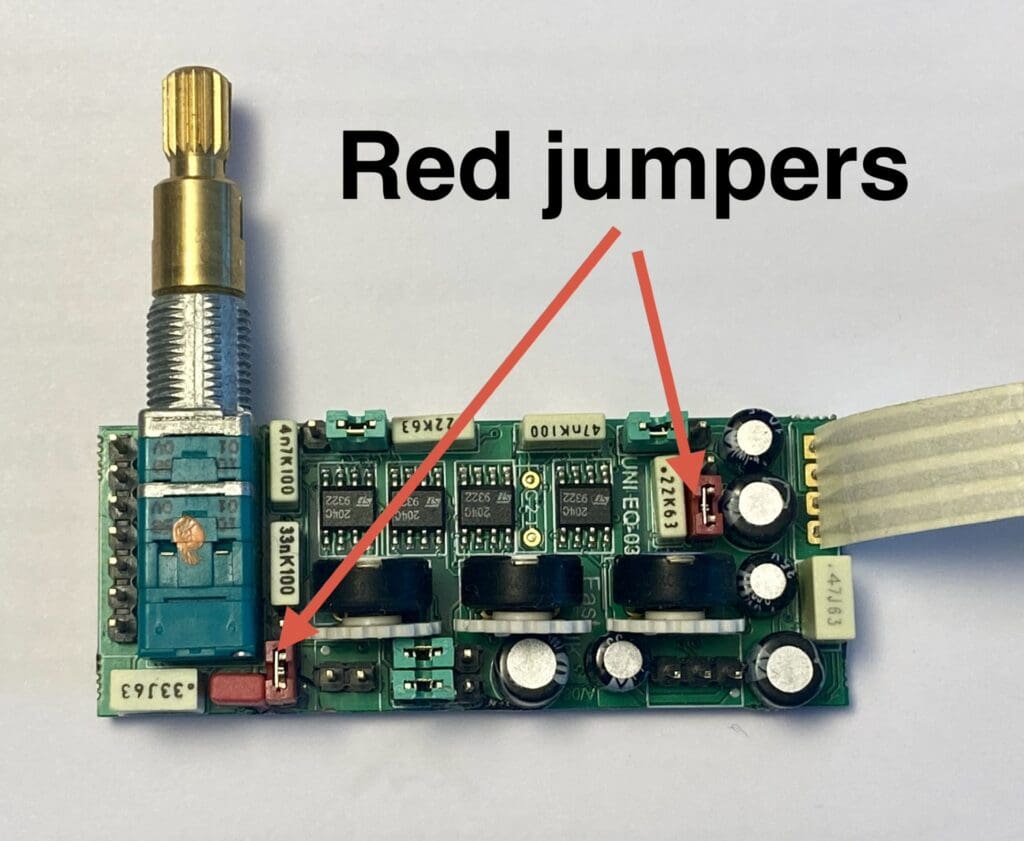
Please check red jumpers are present as shown in pic https://www.east-uk.com/wp-content/uploads/2026/06/red-jumpers.jpg
On many East UK preamps, the treble control includes a Pull for Bright function.
This adds extra high-frequency lift or presence without needing to overuse the main treble control.
It is especially useful when a little extra top-end detail is needed, but the exact result depends on the bass, pickups, strings and amplifier.
Some Stingray 5 instruments have a three-way switch that is integrated into the original preamp circuit rather than acting as a simple standalone pickup selector.
The East UK preamp can be used, but the switch wiring may need to be changed. Options include rewiring the existing switch to an East UK diagram, using a spare EB switch, permanently wiring the pickup to a preferred setting, or using a standard series/parallel switch where suitable.
Because the original switch can be part of the gain structure, this installation is not always straightforward.
A worn or weak battery can recover voltage when it is not under load, then sag immediately when the preamp tries to start.
The circuit may begin to power up, the battery voltage collapses, the chips shut down, and then the battery recovers enough for the cycle to repeat.
This can create a repeating noise. Test with a brand-new quality battery before assuming the preamp is faulty.
Passive mode bypasses the active electronics, but it does not disconnect the battery while a jack plug is inserted.
If the battery were switched on and off when changing between Active and Passive, the sudden voltage change would create a loud thump through the amplifier as the circuit powered up or down.
The battery is switched off by removing the instrument cable from the jack socket. This is normal for onboard active preamps.
Shielding the control cavity can be useful, but it is usually more important to shield the pickup cavities first.
Most interference is picked up by the pickups themselves, especially single coils.
If pickup cavity shielding is added, connect each shield back to the instrument ground so the shielding is actually effective.
The stock Marcus-style preamp is only part of the sound.
Marcus Miller’s recorded tone also depends on the bass, pickups, strings, technique, amplification, recording chain and additional EQ used after the instrument.
The Marcus Retro is designed to get closer from the bass itself by adding useful low end, presence, bright function and mid sweep control.
A weak battery can show a reasonable voltage when measured with no load, but collapse as soon as the preamp draws current.
When this happens, the preamp may repeatedly try to power up and then shut down, causing noise, distortion or intermittent behaviour.
Always check battery voltage under load, with the battery connected and the preamp switched on.
The UNI-PRE uses separate active and passive signal paths.
In passive mode it retains a genuine passive blend path, so the result still depends on the pickups. In active mode the blend is handled after buffering, giving a smoother and more predictable response.
This design was chosen to retain passive operation while also providing a reliable active blend.
If the sound becomes thin or loses bass when the blend is set near the centre, the pickups may be out of phase with each other.
This can happen if one pickup uses an unexpected wire colour convention, as can occur with some Lakland installations.
Reversing the hot and cold connection on one pickup usually corrects a phase problem.
The plate version of the Marcus Retro is intended for four-string Marcus signature basses and is not suitable for the five-string plate.
For a five-string version, the non-plate Marcus Retro may be fitted to the existing plate, but the knob spacing may require slight hole modification.
If the pickup toggle is also installed, an additional hole may be required.
For the East UK barrel jack wiring, the orange wire connects to the very small tag.
The black battery wire connects on its own to the slightly larger switched tag.
The green wire and any other ground wires connect to the larger tag connected to the outer shell. The black battery wire should not share its tag with ground wires.
A passive blend depends heavily on the impedance and characteristics of the pickups connected to it.
Some pickup combinations blend smoothly. Others interact with the passive blend pot in a way that makes the control feel closer to a three-position switch.
This is a known limitation of passive blending rather than a fault in the preamp. Active blend designs avoid this by buffering each pickup before blending.
A slightly bent inner shaft can sometimes be straightened, but it must be done with great care.
Remove the knobs and identify where the inner shaft is touching the outer shaft. Using larger pliers, gently apply firm pressure in the opposite direction.
Do not make sharp movements. The shaft can shear if forced. If unsure, return the unit for service.
Single-coil pickups are naturally more prone to radiated hum and buzz than hum-cancelling designs.
A preamp may make the noise more apparent because it opens up the sound and can boost parts of the frequency range, but it does not create the pickup noise itself.
Shielding the pickup cavities and using proper grounding can help. Hum-cancelling pickups may reduce the issue further.
Yes. Two 9V batteries can be wired in parallel to extend operating time while keeping the system at 9V.
For parallel wiring, connect red to red and black to black, then connect the combined red and black pair to the preamp supply connections.
Do not confuse parallel 9V wiring with series 18V wiring, as they are different arrangements.
Reversing pickup wires will not normally damage the pickup or the preamp.
The usual issue is phase rather than damage. If two pickups are out of phase with each other, the combined sound can become thin and weak, especially with both pickups blended together.
If the sound loses bass at the centre blend position, check the pickup phase wiring.
First check the spacing between the upper and lower knobs. The upper knob can be loosened with a 2mm hex driver, raised slightly and retightened. The lower knob can also be lowered slightly if needed.
Make sure the upper knob is level when tightened, as it can rock slightly.
If the clearance changes as the knob turns, the inner shaft may be slightly bent from an impact.
Where pole pieces are visible and close to the strings, the magnetic field is closer to the string vibration.
This can give a more percussive sound because the magnetic pull has more effect on the vibrating string.
Pickups with bar magnets set further back can produce a more even and sustained sound because there is less direct magnetic pull on the strings.
To wire two 9V batteries in series for 18V, the red wire from the additional battery clip connects to the black wire of the original battery clip. Insulate that joint.
The remaining black wire from the additional battery clip then goes to the jack terminal where the original black battery wire was connected.
This produces 18V from two 9V batteries. If you are unsure, have the wiring checked before connecting the preamp.
Some Lakland instruments use the black wire as Hot on one pickup to maintain correct phase between the two pickups.
If both pickups are wired using the same assumed colour convention, the pickups may be out of phase. The usual symptom is that the sound becomes thinner and loses bass as the blend is moved toward an equal mix of both pickups.
Check the blend response before assuming the wiring colours follow the usual convention.
In many cases, a damaged plate-mounted pot or a pot on a suitable assembly can be replaced by East UK.
If a shaft has been badly bent, or if straightening is not possible, returning the unit for service may be the safest option.
Do not apply sharp force to a bent shaft, as it may shear.
Running at 18V increases headroom. It does not increase the gain of the preamp and does not change the basic EQ character.
The benefit is that larger signal peaks can pass through the circuit before clipping.
Most players use 18V for extra headroom, especially with high-output pickups or strong EQ boost.
If the battery low indicator blinks briefly as the jack is unplugged, that can be a normal sign that the battery is being disconnected.
As the circuit powers down, the voltage passes through the indicator threshold and the LED may flash momentarily.
This suggests the battery switching is probably working correctly.
East UK replacement plates are intended for SUB and OLP instruments.
Ernie Ball Music Man plates are slightly longer, so the East UK plates are not normally a direct replacement for an EBMM bass.
For an Ernie Ball Music Man instrument, the original plate should usually be retained and the preamp fitted to that plate where appropriate.
Battery life matters, but the design priority is audio performance.
Using separate EQ stages and high-quality circuit choices can require more current than simpler designs, but gives a more precise and less compromised sound.
A good battery normally provides practical playing time, so the circuit is not designed around minimum current draw at the expense of tone.
An active preamp can generate much higher signal levels than a passive bass, especially with EQ boost added.
Using full volume with a lot of boost can reduce headroom and may overload the preamp output, pedals, DI input or amplifier input.
Set the amp level from Passive mode first, then switch to Active, set the EQ, and adjust the bass volume to suit. Treat the preamp volume more like a mixer channel fader than a passive bass volume control.
Battery drain is often caused by incorrect jack wiring or a short around the battery switching terminal.
The black battery wire must be connected to the jack ring terminal on its own. No ground wires, shielding foil or other conductors should touch that terminal.
With no jack inserted, the battery should be disconnected. With a mono jack inserted, the battery negative should connect to ground and switch the preamp on.
If the noise reduces when you touch the strings, bridge, jack or control plate, the upper knob may be losing its ground connection while being rotated.
In that situation your hand is temporarily providing the missing ground path, which is why the noise changes when you touch a grounded part of the bass.
A small grounding spring between the upper and lower knobs can help maintain ground contact.
East UK designs come from a pro-audio approach, with the signal path treated as the highest priority.
Each EQ section is tailored carefully, with low noise and reduced interaction between bands. This makes the EQ feel more like a small mixer channel strip designed for bass rather than a simple tone circuit.
The result is a more focused and controlled response, with the trade-off of more complex circuitry.
Check that the jack socket is tight and does not move when a cable is inserted.
Make sure the jack has not twisted and pulled the wires tight. Gently check each wire connection to the preamp and jack.
Dirty jack contacts can also cause intermittent signal. They may need cleaning with a suitable contact cleaner, or the jack may need replacing if the fault persists.
East UK preamps tend to use separate amplifier stages for each EQ band, while many simpler designs combine several EQ bands around one stage.
Separate stages reduce interaction between controls and allow each EQ section to be tailored more accurately.
The trade-off is higher current draw, but the benefit is a more focused and powerful EQ.
The J-Tone bass control can be set for Boost/Cut or Boost Only operation using the jumper link on the circuit board.
On the board, look for the three-pin header near the middle knob pair. The two-pin jumper is normally fitted from the centre pin to the left pin for Boost/Cut operation.
Move the jumper so it links the centre pin to the right pin to set the bass control to Boost Only.
Disconnect the battery before changing internal settings.
The MPB-01 combines a piezo input stage with a four-input mixer stage.
The piezo section includes gain trim and provision for high-frequency roll-off. The mixer section allows magnetic and piezo sources to be combined correctly.
It is intended for more complex instruments using multiple magnetic and/or piezo signals.
Disconnect the pickup wires from the preamp inputs.
Fit a short piece of wire between Hot and Cold on each pickup input terminal, effectively shorting each input.
Turn up the treble and listen. There should be no buzz or interference from the preamp alone, although a slight even hiss may be normal.
Battery life depends on battery quality, capacity, playing time and the preamp model.
As a rough example, a regular industrial 9V battery should provide around two months of use if playing three-hour gigs every day.
Battery consumption is considered in the design, but audio performance is given priority.
As a rough clock-face guide, the J-Tone bass frequency wheel is around 40Hz at about 9:15.
The treble frequency wheel is around 4kHz at about 2:30.
These are theoretical guide positions only. Component tolerances, pickup response, strings and the instrument itself will all affect the final sound.
SPM modules are single-pot EQ modules that can be combined according to the installation requirement.
They allow bass, mid and treble sections to be selected and arranged in a more custom way than a standard preamp assembly.
Internal frequency controls allow the EQ to be tuned to the instrument and player preference.
The preamp does not create pickup interference by itself. It amplifies the signal present at its inputs, including both the wanted string signal and any unwanted noise already being picked up by the pickups.
Because the sound is more open and the EQ can boost certain ranges, existing noise may become more noticeable.
If noise is present, check pickup shielding, grounding and pickup type before assuming the preamp is faulty.
The pots used in East UK preamps are sealed units.
If cleaner gets inside, it can remove the control damping and may not solve the real problem. In many cases, scratchy noise is caused by intermittent shaft grounding rather than dirt inside the pot.
Before using cleaner, check whether the noise disappears when you touch a grounded part of the bass.
The frequency wheel positions are useful starting points, but they should not be treated as exact laboratory settings.
The small components required inside an onboard preamp have tolerances, so the exact frequency can vary slightly. Achieving exact switched frequencies would require larger close-tolerance parts, which are not practical in this type of compact bass preamp.
The best setting is the one that works with the instrument and sounds right to your ears. Music is not about numbers alone.
The MID SWEEP 01 is a standalone midrange control module.
It can be used on its own or cascaded with other modules. The sweep range is switchable on the circuit board using DIL switches, giving two overlapping frequency ranges.
It is useful where a focused adjustable mid control is required.
East UK preamps are handmade in small quantities in the UK rather than manufactured in very large batches overseas.
The price reflects UK labour and overheads, imported specialist components, dealer margins where applicable, and the decision not to reduce the signal path quality simply to cut cost.
The design priority is performance and reliability rather than lowest possible manufacturing cost.
A small amount of mechanical movement in stacked pots is normal, especially on push-pull versions.
The movement is mainly caused by the compact switch mechanism. Replacing the pot with a new one of the same type will usually feel similar.
This does not normally affect the electrical performance of the preamp.
The original Pre-EB Music Man input stage was not designed to work with a passive blend control. Simply adding a blend control to that circuit is unlikely to give satisfactory results.
East UK recreates the original input character where that is needed for the Music Man sound, but also provides an alternative user-selectable input setting that can be used where a blend control is required.
If a blend is needed, use the alternative input setting rather than trying to force a blend control into the original-style input stage.
The BTBM-01 combines the BTB bass/treble control with a two-input mixer stage.
The mixer allows two separate signals, such as magnetic pickups and a piezo preamp, to be mixed electronically without the compromise of simple passive mixing.
It is useful where two sources need to be combined correctly before further processing.
Remove the feet and take out the four screws. Very early units may not have these screws.
Use a stiff, thin-edged tool to carefully prise between the base and side wall. It does not need to be sharp.
The base sits in a groove around the sides. Once both sides are freed slightly, the base can be pulled out.
East UK uses custom Japanese ALPS potentiometers because they are reliable, compact and consistent.
These parts are made to the required size and specification for the preamp assemblies. Larger alternatives may feel different, but often will not fit into the compact J-Retro style layouts.
Many East UK units have been in use for well over fifteen years with their original pots still working correctly.
Occasionally we have graded plates available. These are new plates with minor cosmetic marks or finish issues.
In most cases the marks are very small and only noticeable on close inspection. Once the plate is fitted and in normal use, ordinary handling usually makes these marks much less noticeable.
Availability changes, so graded plates should be treated as occasional stock rather than a standard product option.
The BTB-01 is a compact bass and treble module based on the bass/treble section of the J-Retro 01.
It uses a single stacked control with Bass, Treble and Pull for Bright.
It is intended for installations where a simple high-quality two-band EQ is required.
It is usually better to change one part of the system at a time.
Keeping the original pickups when first fitting the preamp lets you hear what the preamp itself has changed.
If you change pickups and preamp together, it becomes much harder to know which part is responsible for anything you like or dislike.
EMG systems normally use lower-value pots, while East UK passive tone circuits are generally designed around passive pickups.
East UK uses the same capacitor values for the tone roll-off, so the maximum tone effect is similar, but the rotation versus effect will not feel the same.
With EMGs, the tone change may occur more toward the darker end of the control rotation.
The Battery Low Indicator shows when the battery voltage is falling toward the end of useful life.
The warning starts while some useful battery life remains, giving time to replace the battery before failure during use.
The indicator uses extremely little current, so its effect on overall battery life is insignificant.
Even with a flat response circuit, the pickups are buffered by the preamp.
Buffering reduces the effect of instrument cable capacitance, which can otherwise roll off some high frequency content from passive pickups.
For this reason, Flat Response can still sound slightly more present than a purely passive cable-loaded signal.
Yes. The active electronics work well with EMG pickups.
The pickups feed the preamp input buffer stages rather than feeding the controls directly, so the preamp can work with both passive high-impedance pickups and active lower-impedance pickups.
The passive tone value differs from the usual EMG pot value, so the tone effect may occur more toward the backed-off end of the control rotation, but the overall tone roll-off remains usable.
Like the original Pre-EB units, the MMSR is not intended to add extra amplification when the controls are at their midpoint settings.
The input stage and treble behaviour are designed to preserve the expected interaction with the pickup.
The classic sound depends on the pickup, bass construction, circuit and player together, not extra gain from the preamp alone.
The standard Pre-Shape version has a gentle built-in lift in the low and high frequencies. This gives a slightly fuller and brighter starting point.
The Flat Response version is intended to retain the original pickup response when the EQ controls are set neutrally, apart from the buffering effect of the preamp.
Both versions can produce a wide range of sounds. The difference is the starting point.
Use adhesive copper foil on the inside face of the cavity where the pots are mounted, making sure the pot bodies contact the foil.
Connect the foil to ground, usually by soldering the loose ground wire from the jack ground connection to the foil. The bridge ground should also connect to the same ground point.
The exact solder location is not critical, as long as the foil and ground wiring are electrically connected.
The MMSR is designed with characteristics very close to the original Music Man Stingray EQ, but it is not simply a copy of the original circuit.
The design keeps the important interaction and response that players expect, while allowing East UK control layouts and options such as the sweepable mid on three-band versions.
The Stingray sound comes from the whole instrument, not the preamp alone.
To compare Active and Passive levels, first set the internal pickup gain presets fully backed off.
On a standard pre-shape unit, Active mode may still have a slight lift in the lows and highs. On a Flat Response unit, the levels should be very similar.
The pot bodies need a ground connection so the control shafts and metalwork do not become a source of noise.
On plate-mounted units, the plate often provides this connection. On rear-mounted installations, adhesive copper foil on the inside face of the cavity can be used so the pots make contact with a grounded surface.
The bridge ground and the jack ground should also be connected to the same ground system.
For various technical reasons, including the low impedance volume control (5kOhm), it’s not viable.