For various technical reasons, including the low impedance volume control (5kOhm), it’s not viable.
The original Pre-EB Music Man input stage was not designed to work with a passive blend control. Simply adding a blend control to that circuit is unlikely to give satisfactory results.
East UK recreates the original input character where that is needed for the Music Man sound, but also provides an alternative user-selectable input setting that can be used where a blend control is required.
If a blend is needed, use the alternative input setting rather than trying to force a blend control into the original-style input stage.
East UK replacement plates are intended for SUB and OLP instruments.
Ernie Ball Music Man plates are slightly longer, so the East UK plates are not normally a direct replacement for an EBMM bass.
For an Ernie Ball Music Man instrument, the original plate should usually be retained and the preamp fitted to that plate where appropriate.
Some Stingray 5 instruments have a three-way switch that is integrated into the original preamp circuit rather than acting as a simple standalone pickup selector.
The East UK preamp can be used, but the switch wiring may need to be changed. Options include rewiring the existing switch to an East UK diagram, using a spare EB switch, permanently wiring the pickup to a preferred setting, or using a standard series/parallel switch where suitable.
Because the original switch can be part of the gain structure, this installation is not always straightforward.
The MMSR is designed with characteristics very close to the original Music Man Stingray EQ, but it is not simply a copy of the original circuit.
The design keeps the important interaction and response that players expect, while allowing East UK control layouts and options such as the sweepable mid on three-band versions.
The Stingray sound comes from the whole instrument, not the preamp alone.
Like the original Pre-EB units, the MMSR is not intended to add extra amplification when the controls are at their midpoint settings.
The input stage and treble behaviour are designed to preserve the expected interaction with the pickup.
The classic sound depends on the pickup, bass construction, circuit and player together, not extra gain from the preamp alone.
Our MMSR 4K 3B has been used with lots of Stingray 5s, but it’s not entirely straightforward due to the 3 way switch.
Some versions have the 3 way switch with two wire pickup output while others have a ‘multi-wire’ output feeding the original preamp.
* If you don’t use the switch, and prefer to leave the pickup in just series, or parallel and never change it, then your pickup could be permanently wired for your favourite setting, without the switch.
* If you just use series and parallel, then it should be possible to buy and alternative standard switch, for series / parallel.
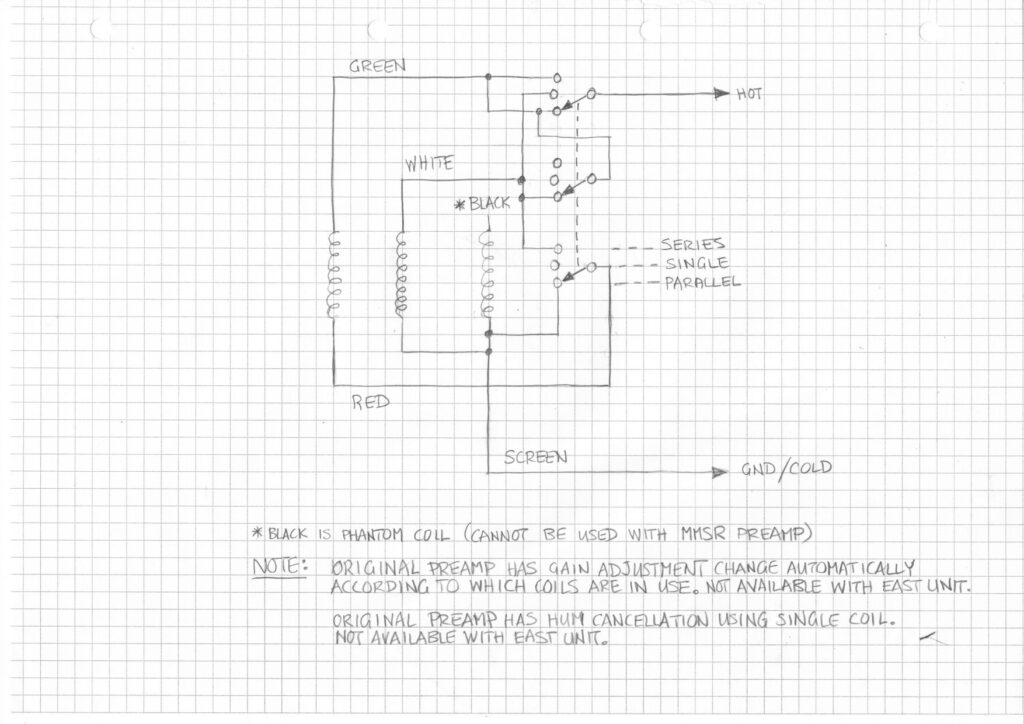
* Alternatively, you could buy a spare switch from EB and use that according to the diagram below. In this case, the original switch can be left wired to the original preamp, if you wanted to retain it in its original stock condition.
* It is possible to wire the ‘multi-wire’ 3 way switch according to the diagram we’ve sketched below but the current switch must be un-wired from the original circuit. This modification means our preamp will not change the gain according to which coils are selected (as was designed into the original circuit).
+ The frequency of the Treble is very high, probably the highest around in bass preamps, tending to bring out just the characteristic Stingray sizzle factor.
+ Does your rig have a tweeter?
+ If it’s the sizzle that’s missing, we’ve found that some after-market pickups don’t have the same characteristics as an original MM pickup (I’ve not had an Aguilar to confirm either way), always best to change one item at a time so that you know the exact individual differences caused by each item.
There’s a jumper that you can change position which often helps aftermarket designs helping with the treble. It activates a different input stage, check which way is best.
+ The Bright is mimicking the Sabre Bright, which is extremely subtle like the Sabre basses. It adds just and extra slight high end edge.
+ Is the EQ fully working, bass/treble & mid/sweep?
Some tests you can do to check if either of the modules appears to attenuate the signal level:
+ The Orange Wire (Oe for short), which feeds the jack, can be disconnected from the Mid Sweep module.
• Then you can use as a signal tracer when the bass is connected to a rig.
+ To check the raw PU signal:
• Connect Oe in parallel with the Red wire going into the Bass/Treble module.
• Is the raw PU signal at a reasonable level?
• So this is the reference signal and level the Bass, Mid, and Treble EQ has to work with.
• (Remove the Oe wire once the test is complete)
• Do you have the original PU?
• Some aftermarket PUs can have lower output than original MM PUs.
+ To check the Bass/Treble module assuming the raw PU signal is OK:
• Remove the Yellow Wire from the 3W Screw Terminal.
• Insert the Oe wire in its place and tighten. (Bypassing the Mid)
• With Bass & Treble in their centre clicks, is the level about the same as the raw PU?
• Do the Bass & Treble controls boost to good additional level when turned CW?
• There is a Red Jumper Link in the middle of the circuit board, swapping the setting (middle and pin by green pot) often improves aftermarket pickups.
• Findings from the tests above?
• Return the Yellow Wire to the middle aperture of the 3W Terminal Block.
+ Assuming the level and operation of the Bass/Treble is satisfactory, to check the Mid:
• Oe returned to the middle aperture of the Mid 3W Terminal Block.
• With upper Mid knob in its click, is the signal level the same as the Bass/Treble set in their clicks?
• Upper knob CW to max boost and sweep the lower knob to sweep through its frequency range.
+ Like the original Pre-EB MM EQs, the East MMSRs don’t add any gain when the EQ knobs are set to neutral.
The MMSR preamp’s compatibility with the 5-string Stingray is complicated by the 3-way pickup selector switch. Workarounds include rewiring the existing switch, installing a separate switch for the East UK preamp, or permanently wiring the pickup in a preferred configuration.